DHS Shuts Down As World Leaders Question If America Can Be Trusted Anymore
The Department of Homeland Security headquarters, Washington D.C., February 14th, 2026, eleven forty-seven PM. Three hundred and eighteen employees received automated text messages informing them that if Congress failed to pass a funding bill by midnight, they would be furloughed effective immediately. Security personnel at airports across the country began preparing contingency plans for reduced staffing. Border Patrol agents in Texas, Arizona, and California were told to expect delayed paychecks. The third-largest federal department, responsible for everything from aviation security to disaster response to immigration enforcement, was thirteen minutes away from a partial shutdown.
Six thousand miles away in Munich, Germany, world leaders were gathering for the Munich Security Conference, an annual meeting where defense ministers, foreign secretaries, and heads of state discuss global threats and coordinate strategy. This year’s conference was scheduled to focus on artificial intelligence in warfare, Middle East stability, and the ongoing war in Ukraine. But the real story unfolding in Munich had nothing to do with the official agenda. It was about what American allies were saying privately about the reliability of the United States, about whether commitments made by one administration would survive into the next, about whether NATO could function when its most powerful member seemed unable to govern itself.
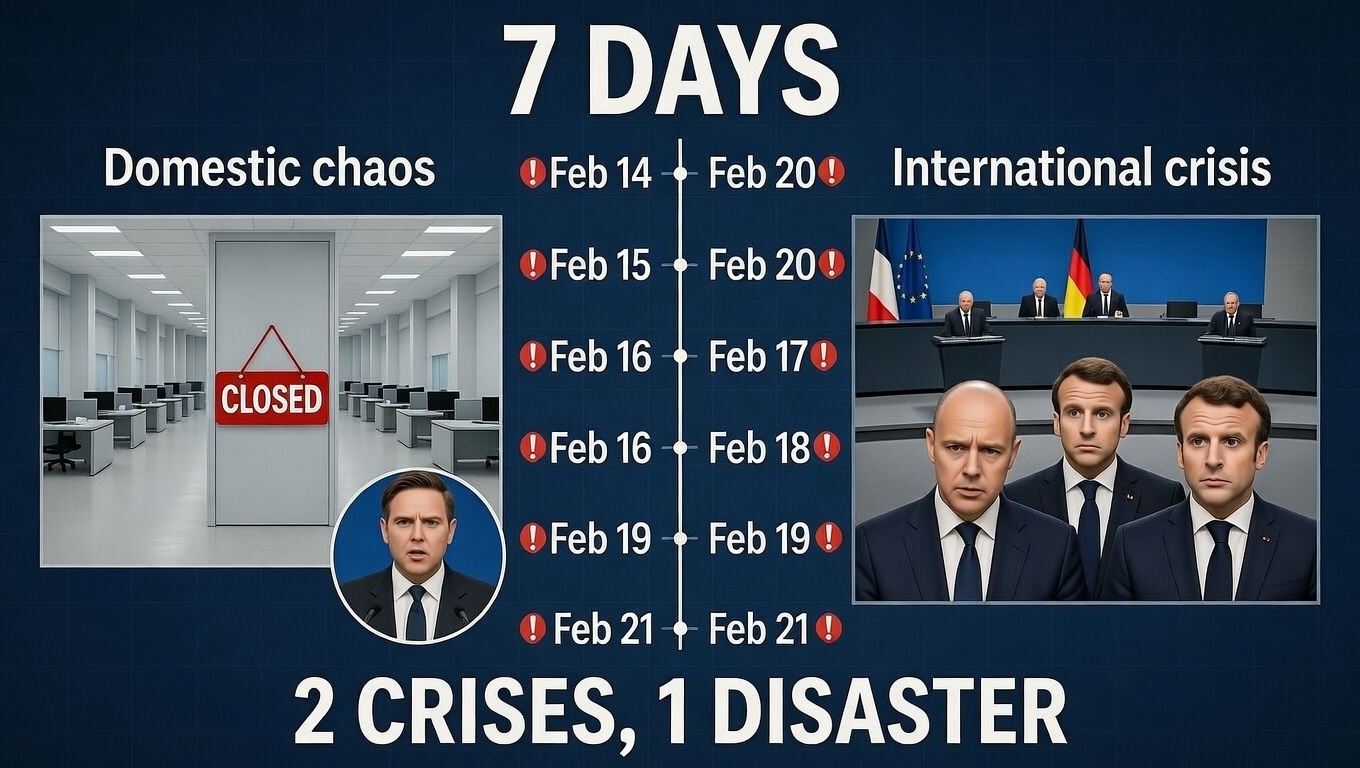
These two crises, one domestic and one international, were unfolding simultaneously on February 14th and 15th, 2026. They appeared unrelated on the surface. A budget fight in Washington. A diplomatic conference in Europe. But they were connected by a common thread. Both revealed a United States government struggling with internal dysfunction at a moment when global challenges demanded coherent leadership. Both demonstrated how domestic political battles have international consequences that ripple far beyond American borders.
To understand how the Department of Homeland Security ended up on the brink of shutdown, you need to go back three weeks to January 24th, when the current funding crisis began.
Federal agencies operate on budgets approved by Congress. When Congress cannot agree on full-year budgets, which has become increasingly common, they pass continuing resolutions, temporary measures that fund agencies at previous years’ levels for a few weeks or months. The Department of Homeland Security had been operating under a continuing resolution since the start of the fiscal year in October 2025. That resolution was set to expire on February 15th at midnight.
Normally, Congress would pass another continuing resolution to keep the lights on while negotiating a full-year budget. This is standard procedure, happened dozens of times over the past two decades. But February 2026 wasn’t normal.
The proximate cause of the funding impasse was an amendment introduced by Representative Matt Gaetz of Florida on January 24th. The amendment would prohibit any DHS funds from being used to process asylum applications from individuals who entered the country between ports of entry. In plain language, it meant that migrants who crossed the border illegally, even if they immediately sought asylum as legally permitted, would be automatically ineligible for asylum consideration. Their applications wouldn’t be processed. They’d be detained and deported.
Gaetz argued this was necessary to deter illegal border crossings. If people knew they couldn’t claim asylum after crossing illegally, they’d use official ports of entry. The amendment, he said, would restore order to the border and stop the abuse of asylum laws by economic migrants.
Democrats and immigration advocates argued the amendment violated U.S. asylum law and international treaty obligations. The 1951 Refugee Convention, which the United States ratified, requires countries to consider asylum claims from anyone who arrives at their territory, regardless of how they arrived. The amendment would effectively end asylum for the vast majority of claimants, since most cross between ports of entry due to long wait times and limited capacity at official crossings.
The legal arguments were complex, but the political dynamic was straightforward. Conservative Republicans demanded the Gaetz amendment as the price for supporting any DHS funding bill. Moderate Republicans and Democrats refused to accept it. Neither side had the votes to pass their preferred version. The result was deadlock.
The House narrowly passed a funding bill with the Gaetz amendment on February 7th, 219 to 216, with six Republicans joining Democrats in opposition. The Senate, where Republicans held a slim 52 to 48 majority, couldn’t muster the sixty votes needed to overcome a Democratic filibuster. Democrats offered to support a clean funding bill without the amendment. Republicans refused to bring such a bill to a vote.
Negotiations throughout the week of February 10th went nowhere. Both sides accused the other of refusing to compromise. Speaker Mike Johnson said Democrats were holding DHS funding hostage to protect illegal immigration. Senate Majority Leader John Thune said Republicans were manufacturing a crisis to force through extreme policy changes. President Trump tweeted that any Republican who voted for funding without the Gaetz amendment would face a primary challenge.
By February 14th, with hours remaining before the deadline, no deal was in sight. The White House announced it was preparing for a partial DHS shutdown. Essential personnel, about sixty-two percent of the department’s workforce, would continue working without pay. Non-essential personnel would be furloughed. Programs and services deemed non-critical would halt.
What does that actually mean in practice? TSA officers would continue screening passengers at airports, but with reduced staffing leading to longer lines. Border Patrol agents would continue apprehending migrants, but processing would slow dramatically. Immigration judges would stop hearing non-detained cases, creating bigger backlogs. FEMA would continue responding to active disasters but couldn’t approve new preparedness grants. The Secret Service would continue protecting the president but would suspend financial crimes investigations. Coast Guard ships would continue patrols but shore-based support would be reduced.
The impact wouldn’t be catastrophic immediately. Essential security functions would continue. But over time, the degradation would compound. Unpaid employees would face financial stress. Some would call in sick. Others would seek other jobs. Morale would plummet. The department’s ability to perform its mission would steadily erode.
Government shutdowns had happened before, most recently in 2018-2019 when a dispute over border wall funding led to a thirty-five day partial shutdown. But that shutdown didn’t include DHS. This would be the first time the department responsible for homeland security operated without full funding during a partial shutdown focused specifically on its operations.
Security experts warned of genuine risks. A degraded TSA creates vulnerabilities in aviation security. Reduced Border Patrol capacity creates gaps that smugglers exploit. Delayed immigration processing creates humanitarian problems as people remain in detention longer. These weren’t hypothetical concerns. They were operational realities of running a massive security apparatus without adequate resources.
The political calculation for both parties was different than in previous shutdown fights. Republicans believed they were on strong ground politically. Border security polled well. Voters wanted tougher immigration enforcement. If Democrats blocked DHS funding over asylum policy, Republicans would blame them for choosing illegal immigrants over homeland security.
Democrats believed Republican overreach would backfire. Shutting down homeland security over an extreme policy that violated international law and U.S. treaty obligations wasn’t a winning message. Voters wanted border security, but they also wanted government to function. Creating a crisis to force through controversial policy changes looked irresponsible.
Both sides were gambling that public opinion would break their way. Both believed the other would eventually blink. Both were wrong about the other’s willingness to compromise.
As midnight approached on February 14th, neither side had blinked. The House remained adjourned. The Senate had gone home. No votes were scheduled. At 11:59 PM Eastern Time, the continuing resolution expired. The Department of Homeland Security entered partial shutdown status.
The immediate impact was minimal. It was late at night. Most employees weren’t working anyway. But come Monday morning, February 17th, the furloughs would take effect. Pay would be delayed. Services would be reduced. The dysfunction would become visible.
While Washington fought over budget minutiae, Munich was hosting a very different kind of drama. The Munich Security Conference brings together roughly five hundred world leaders, defense officials, and security experts every February. It’s not a decision-making body. No treaties are signed, no binding commitments made. But it’s an important venue for relationship building, for behind-the-scenes diplomacy, for taking the temperature of the international security environment.
The conference began on Friday, February 14th, the same day the DHS shutdown began in Washington. The timing was unfortunate for the Trump administration. American officials attending the conference immediately faced questions about whether the United States could be a reliable partner when it couldn’t keep its own government funded.
Vice President JD Vance led the American delegation. In his keynote speech on Friday afternoon Munich time, he emphasized America’s commitment to allies and partners. He said the United States remained the cornerstone of the liberal international order. He promised continued support for Ukraine, for NATO, for democratic values worldwide.
The speech was well-received in the hall. Polite applause. Diplomatic nods. But in private conversations over the next twenty-four hours, a different story emerged. European officials expressed deep skepticism about American reliability. Not because of anything Vance said, but because of the context in which he was saying it.
Consider the perspective of a German defense minister or French foreign secretary. They watch American politics closely. They’d seen Trump win reelection in 2024 promising to reduce American involvement overseas, to make allies pay more for their own defense, to prioritize America first. They’d watched his first term’s erratic foreign policy. Then Biden won in 2020 and reassured allies of American commitment. Then Trump won again in 2024 and immediately began reversing Biden’s policies.
From a European perspective, the problem isn’t any specific American policy. It’s the unpredictability. Commitments made by one administration get reversed by the next. Long-term planning becomes impossible when the world’s most powerful country changes strategic direction every four years.
The DHS shutdown amplified these concerns. If America can’t pass basic funding bills, how can allies trust complex multi-year defense commitments? If domestic politics paralyzes the government over immigration policy, what happens when real security crises demand decisive action?
These concerns were expressed delicately in public. French President Emmanuel Macron, speaking on Saturday, said Europe needed strategic autonomy, the ability to defend itself without total dependence on the United States. German Chancellor Friedrich Merz said NATO remained vital but Europeans must take more responsibility for their own security. Both framed these statements as complementing rather than replacing American leadership, but the subtext was clear. Europe was hedging against American unreliability.
The most pointed comments came from Radosław Sikorski, Poland’s foreign minister. In a panel discussion on Saturday, he noted that Poland spends over four percent of GDP on defense, among the highest in NATO, because it faces direct threats from Russia. He said Poland had invested heavily in American-made weapons systems and defense partnerships based on trust that America would honor its commitments. He then asked pointedly whether that trust was justified given current American political dysfunction.
The question hung in the air awkwardly. The American official on the panel, Deputy Secretary of State Kurt Campbell, responded that NATO’s Article 5 commitment was ironclad, that the United States would defend every inch of allied territory, that temporary budget disputes didn’t change fundamental strategic commitments. The response was technically correct but emotionally unsatisfying. Everyone in the room understood the deeper question. Not whether America would defend Poland if Russia invaded tomorrow. But whether America would still be a reliable partner in five years, ten years, when political winds in Washington might shift again.
The Ukraine discussion at Munich highlighted these tensions further. Ukraine was not at the conference officially, as it’s not a NATO member, but Ukrainian officials were present informally. They were desperately trying to secure continued Western military and financial support. The war had been grinding on for nearly four years. Ukrainian forces had stopped Russia’s initial invasion, recaptured significant territory in 2022 and 2023, but had made limited progress in 2024 and 2025. The conflict had settled into something resembling World War One trench warfare, with both sides dug in and casualties mounting.
Ukraine needed sustained Western support to continue fighting. Weapons, ammunition, intelligence, training, financial aid to keep the government functioning. But support was fraying. The American Congress, despite Republican control, was divided on Ukraine funding. Some Republicans, particularly those aligned with Trump, questioned why the United States should keep sending billions to Ukraine when domestic priorities went unmet. The DHS shutdown was being used as an example. We can’t fund our own homeland security, these Republicans argued, but we’re sending billions overseas.
This argument was politically potent even if factually misleading. The money for Ukraine came from separate appropriations. The DHS shutdown wasn’t caused by lack of money but by a policy dispute over asylum rules. The federal budget could easily accommodate both homeland security and Ukraine aid. But the political narrative that foreign aid was crowding out domestic needs resonated with voters frustrated by government dysfunction.
Ukrainian officials in Munich could read the room. They saw the uncertainty in European faces. They heard the hedging language about strategic autonomy. They understood that Western support, while not disappearing, was no longer unconditional or guaranteed. That reality forced difficult questions about Ukraine’s strategic options. Keep fighting in hopes of eventual victory? Negotiate a compromise peace that would likely involve territorial concessions? Neither option was appealing, but continuing the war required reliable Western support that seemed increasingly fragile.
Russian officials weren’t at Munich, the conference disinvites them after the invasion, but Russian actions suggested they understood Western divisions. Intelligence reports indicated Russia was preparing a major offensive in eastern Ukraine timed for spring 2026. The calculation seemed to be that Western resolve was weakening, that a significant Russian military success might break Ukrainian morale and Western support, forcing negotiations on Russian terms.
The Middle East discussion at Munich was equally fraught. The Israeli-Palestinian conflict continued without resolution. The Abraham Accords, normalized relations between Israel and several Arab states, had survived but hadn’t expanded. Iran continued uranium enrichment, getting closer to weapons capability. Proxy conflicts between Iran and its adversaries continued in Yemen, Syria, Lebanon.
American officials at Munich tried to project stability and commitment. They emphasized continued security cooperation with Israel and Gulf partners. They warned Iran against nuclear weapons development. They called for de-escalation and diplomatic solutions.
But here too, allied skepticism was evident. Gulf states had watched American policy whipsaw between administrations. Trump’s first term had been strongly pro-Saudi and anti-Iran. Biden had tried to restore the Iran nuclear deal and distance from Saudi Arabia over human rights. Trump’s second term had reversed back to the first-term approach. Gulf leaders questioned whether they could base long-term security planning on relationships that changed dramatically every few years.
Israeli officials had similar concerns. Trump was strongly pro-Israel, but he’d be gone in three years at most. The next president might be very different. Could Israel take major security risks based on current American assurances that might not survive the next administration?
These questions about American reliability created strategic paralysis. Allies wanted American leadership but couldn’t fully trust it. They were reluctant to take major strategic risks based on American commitments that might evaporate. The result was a more cautious, tentative international order where American influence was diminished even when American power remained formidable.
The China discussion revealed another dimension of allied concerns. The Trump administration had made confronting China its top strategic priority. Vance’s speech in Munich emphasized the need for democratic nations to coordinate their China policies, to present a united front against Chinese economic coercion and military expansion.
This message had broad support in principle. European governments were increasingly wary of Chinese influence. They’d seen Chinese investment in strategic infrastructure. They’d experienced Chinese economic pressure when they criticized human rights abuses. They understood the challenge.
But coordination required trust that policies wouldn’t suddenly change. The Trump administration was pursuing aggressive decoupling from China in certain sectors, restricting technology exports, limiting Chinese investment in American companies. Europeans were willing to adopt similar policies if they believed America would maintain them consistently. But what if the next administration reversed course? What if American companies, frustrated by lost Chinese market access, lobbied for policy changes? European governments would be left with the costs of confronting China without the benefits of coordinated American policy.
This uncertainty created divergence where there should have been alignment. European governments adopted more moderate China policies than the United States preferred, hedging against the possibility of future American policy shifts. The result was a less unified democratic response to Chinese challenges.
The broader pattern at Munich was clear. American officials said the right things about commitment and leadership. Allied officials responded with polite agreement in public and deep skepticism in private. The problem wasn’t American intentions or capabilities. It was credibility. The belief that American commitments would be honored not just today but next year, in five years, in ten years.
This credibility gap had real consequences. It made allies less willing to take risks based on American assurances. It created space for competitors like China and Russia to exploit. It undermined the collective action that effective alliance management requires.
Back in Washington, the DHS shutdown continued through the weekend. Attempts at compromise went nowhere. The White House blamed congressional Democrats. Democrats blamed Republican extremists. Moderate Republicans blamed both sides. The finger-pointing accomplished nothing.
By Monday, February 17th, the practical impacts of the shutdown became more visible. TSA screening lines at major airports stretched longer as some officers called in sick rather than work without pay. Border Patrol reported increased crossing attempts in sectors where staffing reductions created gaps. Immigration courts postponed thousands of hearings. FEMA stopped processing grant applications from states seeking disaster preparedness funding.
None of this was catastrophic yet. The security apparatus was degraded but functional. But the trajectory was concerning. How long could essential personnel work without pay before financial stress forced them to quit? How long before the accumulated operational impacts created genuine security vulnerabilities?
Public opinion polling showed Americans were increasingly frustrated with both parties. Roughly sixty-three percent disapproved of how Republicans were handling the situation. Roughly fifty-seven percent disapproved of how Democrats were handling it. Voters wanted the government to function and didn’t care much about the policy details causing the impasse. They just wanted it fixed.
But that public frustration didn’t translate to political pressure strong enough to force compromise. Republicans in deep-red districts faced no electoral consequence for holding firm on the Gaetz amendment. Democrats in deep-blue districts faced no consequence for refusing to accept it. The members who might face electoral pressure, those in competitive swing districts, were too few to change the overall dynamics.
The situation had become a test of willpower. Which side would break first? Which side would face more damage from continued dysfunction? Neither side knew the answer, so both kept fighting.
By Tuesday, February 18th, as the Munich Security Conference concluded, the contrast between America’s stated global ambitions and its domestic dysfunction was impossible to ignore. Vance flew back from Munich having given speeches about American leadership while his own government partially shut down over a budget dispute. European allies flew home with their doubts about American reliability reinforced. The conference had been productive in some ways, relationships were maintained, discussions were substantive, but the underlying question of American credibility remained unresolved and arguably worsened.
The connection between the DHS shutdown and the Munich conference wasn’t just symbolic. It was substantive. International leadership requires domestic stability. Allies need to believe that the country they’re partnering with can govern itself, can honor commitments, can maintain consistent policies across administrations. When that belief erodes, the foundation of alliance structures weakens.
Consider how this affects crisis response. Imagine a security emergency somewhere in the world requiring coordinated action by the United States and its allies. A terrorist attack. A Russian military incursion. A Chinese attempt to seize Taiwan. Effective response demands trust that America will do what it says, that commitments made will be kept, that domestic politics won’t paralyze decision-making at a critical moment.
But if allies watch the United States shut down homeland security over an immigration policy dispute, if they see fundamental government operations held hostage to partisan fights, their confidence in American crisis response capabilities diminishes. They might hesitate before committing their own forces to joint operations. They might develop backup plans that don’t assume American participation. They might pursue independent policies rather than coordinated strategies.
This erosion of trust doesn’t happen dramatically. There’s no single moment when alliances collapse. It’s gradual. Cumulative. Each dysfunction adds to the pile. Each policy reversal raises more doubts. Eventually, the accumulated weight becomes too much. Allies diversify their partnerships. They hedge their bets. They invest in strategic autonomy. American influence declines not because American power diminishes but because American credibility erodes.
The DHS shutdown and the Munich conference together illustrated this dynamic. Neither event alone was decisive. But together, they reinforced a narrative of American unreliability that allies were already inclined to believe based on recent history. The shutdown showed domestic dysfunction. Munich showed the international consequences.
By Wednesday, February 19th, pressure to resolve the DHS funding crisis was mounting. Media coverage of airport delays was generating public frustration. Business groups were lobbying for resolution. Even some conservative Republicans were wavering, concerned that the shutdown optics were hurting the party.
Behind the scenes, negotiations intensified. A small group of senators from both parties began working on potential compromises. Could they modify the Gaetz amendment to address some Republican concerns while removing the provisions Democrats found most objectionable? Could they find middle ground on asylum processing that improved border security without violating international obligations?
The discussions were technical and tedious. Asylum law is complex. The difference between processing asylum claims at ports of entry versus after illegal crossing involves multiple legal frameworks. The 1951 Refugee Convention, the 1967 Protocol, U.S. statutory law under the Immigration and Nationality Act, Supreme Court precedents interpreting that law. Finding a compromise that satisfied both sides required threading multiple legal needles.
By Thursday, February 20th, outlines of a potential deal emerged. Under the proposed compromise, individuals who crossed illegally would have their asylum claims processed, satisfying Democrats’ concerns about treaty compliance. But they would face mandatory detention during processing and expedited procedures with higher burdens of proof, satisfying some Republican concerns about border security. The deal wasn’t perfect for anyone, but it was potentially acceptable to enough members to pass.
The White House signaled support for the compromise. Trump tweeted that it was a good deal that secured the border while keeping DHS funded. Speaker Johnson said he could support it if Democrats would. Senator Chuck Schumer, the Democratic leader, said he was reviewing the details but the framework looked reasonable.
On Friday, February 21st, one week after the shutdown began, the Senate passed the compromise funding bill sixty-eight to thirty-two, with significant bipartisan support. The House passed it the following day, 242 to 193, with most Democrats and about two-thirds of Republicans supporting it. Trump signed it that evening, ending the shutdown after seven days.
The resolution satisfied no one completely. Immigration hardliners thought Republicans had caved. Progressive Democrats thought the party had accepted too many restrictions on asylum. But the government was funded. DHS employees would be paid. Operations would resume normal status.
The week-long shutdown had costs beyond the immediate disruption. TSA estimated that longer security lines had caused approximately thirty-seven thousand passengers to miss flights. Border Patrol reported that reduced staffing had allowed an estimated four thousand additional illegal crossings. Immigration courts had postponed eighteen thousand hearings that would need to be rescheduled. FEMA had delayed processing on two hundred and fourteen grant applications. These weren’t catastrophic numbers, but they represented real harm caused by preventable dysfunction.
The political aftermath was mixed. Republicans claimed victory because the final bill included stronger asylum procedures. Democrats claimed victory because it preserved the right to asylum. In reality, both sides had been forced to compromise. Neither got what they wanted. But government was functioning again, which was more important than either side scoring political points.
The international implications of the shutdown were harder to measure but potentially more significant. The Munich conference had reinforced allied doubts about American reliability. The shutdown resolution didn’t erase those doubts. It demonstrated that the American system could eventually resolve disputes, but only after significant dysfunction and damage.
European officials took away a lesson from February 2026. They couldn’t assume American political stability. They needed to develop capabilities and strategies that didn’t depend entirely on American leadership. This didn’t mean abandoning NATO or transatlantic partnerships. It meant hedging. Building European military capabilities. Coordinating European foreign policies. Preparing for scenarios where American support might not be available.
These hedging strategies had costs for American influence. When allies develop alternative options, American leverage decreases. When European defense capabilities increase, the demand for American protection decreases. The long-term trajectory was toward a more multipolar world where American leadership was less dominant.
That trajectory wasn’t irreversible. If the United States demonstrated sustained competence and reliability, allies would return to closer partnerships. But February 2026 moved the trend in the wrong direction. The DHS shutdown was resolved, but the damage to American credibility persisted.
The episode revealed a fundamental tension in contemporary American governance. Domestic political incentives push toward confrontation and brinksmanship. Congressional Republicans face pressure from conservative voters to fight for maximum policy demands. Congressional Democrats face pressure from progressive voters to resist Republican overreach. Neither party faces sufficient pressure from swing voters to prioritize compromise and functionality.
But international leadership requires stability and predictability. Allies need to trust American commitments. Adversaries need to respect American resolve. Both trust and respect erode when domestic dysfunction makes American policy uncertain and American governance chaotic.
Reconciling these competing demands, satisfying domestic political constituencies while maintaining international credibility, is increasingly difficult. The structural features of American politics, partisan polarization, safe congressional districts, primary elections that reward extremism, all push toward dysfunction. The requirements of global leadership push toward stability.
February 2026 demonstrated what happens when these forces collide. A funding dispute over asylum policy shuts down homeland security. World leaders gather in Munich and question American reliability. The shutdown eventually ends through compromise, but allied doubts remain.
The immediate crisis passed. The DHS was funded. The Munich conference concluded. But the underlying problems, domestic dysfunction, international credibility gaps, competing pressures between domestic politics and global leadership, those problems remained unresolved.
They would resurface in different forms. Another shutdown fight over different issues. Another international crisis where allies hesitated to trust American commitments. Another gap between what America said about its global role and what American politics would actually support.
Managing these tensions would define American foreign policy for years to come. Not through dramatic decisions or definitive moments, but through the accumulated weight of small crises like February 2026. Each one manageable individually. Each one slightly eroding the foundation of American global leadership. Eventually, perhaps, eroding it beyond repair.
Leave a Reply